Why Performance Anxiety Isn’t Your Problem to Fix Alone
WELCOME
Sex and sexuality are universal human experiences, yet the intimacy of the topic makes it a conversation that often happens in hushed whispers and incognito Google searches. So, we are bringing the conversation into the open, with education and resources that embrace the diversity of the human experience. Adults from all walks of life are welcome at GETSOME.
Our approach to sexual education combines compassion with humor to help everyone overcome the often daunting task of addressing sexual shame. Because, no matter who you are or who you love, you deserve to GETSOME.
LEARN MORE
May 19, 2026
I was on Justin Lehmiller’s Sex and Psychology Podcast this week, episode 502, and we spent 35 minutes on exactly this: why the performance framing keeps people stuck, and what a nervous system lens actually changes.
It felt like the right moment to put this in writing.
Performance anxiety in sex is treated like a glitch in the individuals experiencing it.
Something to medicate, breathe through, or push past.
The reframe that actually works is harder and more interesting: the anxiety is the rational response. The body is doing exactly what it was trained to do, in a culture that rigged the test.
Men are handed a definition of sexual success: last long, stay hard, deliver the partner’s orgasm. And almost no instruction in how to actually have sex.
Then we call the resulting nervous system response a disorder.
The anxiety isn’t the malfunction. The script is.
A note on language: this piece uses “men” throughout, because the cultural conditioning at the heart of this argument is gendered, and naming it precisely matters. That conditioning shapes anyone who was raised under it or who moves through the world as a man, including trans men and non-binary people who experience early ejaculation. The clinical work described here is for all of them.
Here’s What We’re Getting Into
ToggleThe script no one wrote down but everyone learned
Nobody sat any of us down and said: here is what sex is for, here is what counts, here is how to know if you did it right.
The script got assembled instead: from porn, from sitcom punchlines, from locker rooms, from the silence where sex education should have been.
The script is remarkably consistent across sources:
- Sex means penetration
- Penetration should last a long time
- The man’s job is to perform
- The partner’s orgasm is the scoreboard
- Finishing “too fast” is the central failure
Consider the phrase lasting longer. It’s so embedded we forget it’s a metaphor.
Lasting through what?
The framing presupposes that sex is an endurance event the man is trying not to lose. Not a shared experience. Not a conversation between two nervous systems. An endurance event. With a clock.
That phrase is the whole script in two words.
What the body does when you hand it that script
The nervous system isn’t deciding whether the script is fair.
It’s responding to a perceived threat: the threat of failing at something that has been culturally framed as a test of manhood.
The sympathetic nervous system activates. Heart rate climbs. Breathing shallows. Muscles tense. Arousal accelerates. Ejaculation arrives faster.
The body is doing its job. In a context rigged to feel like danger, the body responds to danger.
The “anxiety” is a feedback loop:
The script creates the pressure. The pressure activates the nervous system. The nervous system speeds the response. The speed confirms the failure. The failure deepens the script.
This is what gets missed when performance anxiety is framed as an individual psychological problem.
You can teach breathing techniques. Prescribe an SSRI. Send someone to therapy to work on confidence. None of that addresses the script.
He goes back into the bedroom carrying the same definition of success, and his nervous system responds to it the same way.
What therapy has been working around
Sex therapy has known for decades that early ejaculation is biopsychosocial: biological, psychological, and social.
The third part is where the cultural scripts live. It’s also the part most often skipped.
The clinical research is consistent: integrated treatment outperforms any single approach.
- Medication can widen the learning window
- Behavioural techniques build awareness
- But sustained change comes from rewriting what sex is for
The field calls this the Good-Enough Sex model: flexibility over performance, multiple definitions of what counts, penetration as one option rather than the entire event.
This is why “just relax” is such useless advice.
The anxiety isn’t irrational. It’s a reasonable response to a real cultural pressure that doesn’t go away because someone tells him to breathe.
The shift from control to choice
There’s a small but consequential shift in the language sex therapists are increasingly using: from control to choice.
- Control implies mastery over a problem body
- Choice implies a body that has options
Control is the script’s language. It keeps a person in an adversarial relationship with their own nervous system, which is exactly the relationship that produced the anxiety in the first place.
Choice is different.
Choice means slowing down. Pausing. Changing what’s happening. Talking to the person you’re with. It means treating arousal as information rather than a problem to manage.
It means sex has a pause button. And using the pause button isn’t failure.
The shift moves the entire frame from something is wrong with me to I have options here.
The nervous system responds accordingly. Lower threat reads as lower urgency. Lower urgency reads as more time. More time reads as more choice.
This is the actual mechanism by which the cultural reframe becomes biological change. It’s not mystical. It’s the body responding to a different script.
What partners are doing inside the same script
The script doesn’t only land on the individuals experiencing early ejaculation.
Partners are reading from the same cultural material: the same porn, the same sitcoms, the same silence. And arriving at the same definition of what sex is supposed to be.
This means partners often participate in the performance frame without realising it:
- Reassurance gets coded as disappointment
- Suggesting a pause gets read as criticism
- Post-sex silence gets interpreted as judgment when it might just be tiredness
None of this is anyone’s fault. It’s what happens when two people are trying to have sex inside a script that defines success in a way that almost guarantees one of them will feel like they failed.
The way out is communication. Not a debrief. The small ongoing conversation about what’s happening, what’s working, what to try, when to slow down.
Research is consistent: communication reduces anxiety. Anxiety reduction lowers sympathetic activation. Sympathetic activation is the thing accelerating the response.
The cultural problem and the biological problem are the same problem. And they have the same solution.
Where this leaves the men reading this
If you’ve been carrying this as a personal failing, the first thing to know is that the framing was wrong.
You weren’t given a fair definition of sexual success. You absorbed a script that was never going to produce the outcome it promised. And your body responded the way bodies respond to impossible tests.
You are not broken. You learned a pattern. Patterns can be unlearned.
The unlearning starts with naming the script for what it is.
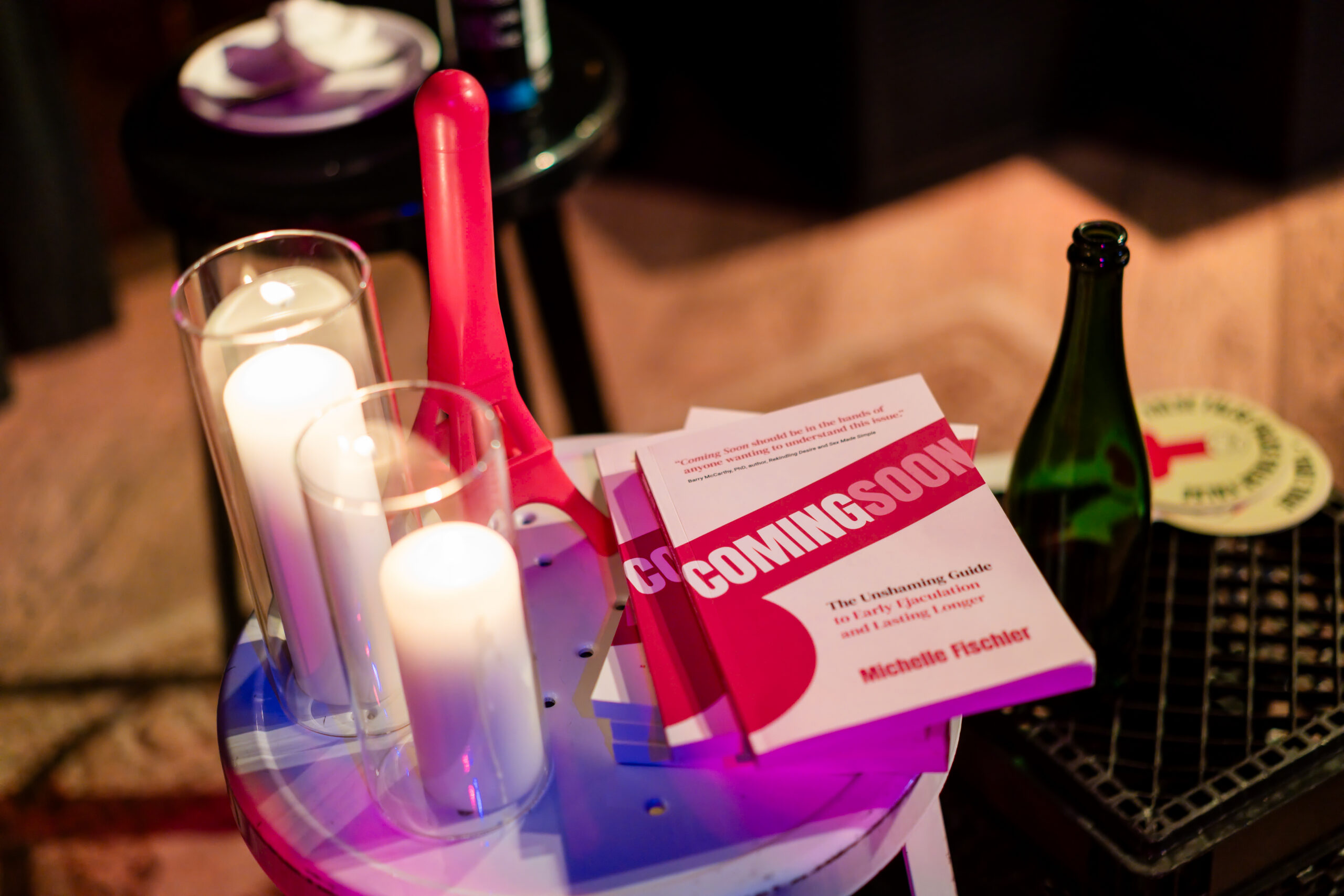
This is the argument I make in Coming Soon: The Unshaming Guide to Early Ejaculation and Lasting Longer. The work isn’t powering through the anxiety. It’s reshaping the cultural and personal definition of what sex is for.
I’ve spent years watching people try to fix themselves with the same tools that created the problem. The book is what I’d rather they tried instead.
The cultural script will not change quickly.
But the script you’re using in your own bedroom can change tonight. That’s where this work actually starts.
Get the book at comingsoonbook.ca
About the author
Michelle Fischler is a Registered Social Worker, Registered Psychotherapist, and ASTO-Certified Sex Therapist and Supervisor based in Toronto. She is the founder of GETSOME INC. and the author of Coming Soon: The Unshaming Guide to Early Ejaculation and Lasting Longer. Her clinical work centres on unshaming sexual concerns and addressing the nervous system patterns that drive them. She can be found at getsome.ca.
Frequently asked questions
What is performance anxiety in sex?
Performance anxiety in sex is a nervous system response to the cultural pressure to meet a specific definition of sexual success: lasting long, staying hard, and delivering a partner’s orgasm. It is not a disorder. It is the body’s rational response to a high-stakes, culturally rigged situation.
Why do men experience performance anxiety during sex?
Because they have absorbed a cultural script that frames sex as a performance with a clear success condition. When the nervous system reads that condition as a threat, it activates the sympathetic response: elevated heart rate, muscle tension, faster arousal, and accelerated ejaculation. The problem is not the body. It is the script the body was handed.
What is early ejaculation?
Early ejaculation is a nervous system pattern in which ejaculation occurs sooner than a person would like during sexual activity. It is one of the most common male sexual concerns, affecting an estimated 30% of men at some point in their lives. It is not a dysfunction. It is a learned pattern that can change, particularly when shame is addressed first.
What is the Good-Enough Sex model?
The Good-Enough Sex model is a clinical framework developed by sex therapists Barry McCarthy and Michael Metz. It replaces the performance-based definition of sex with a flexible approach: multiple definitions of what counts as satisfying sex, penetration as one option rather than the entire event, and mutual pleasure as the goal rather than endurance or orgasm delivery.
How does communication help with performance anxiety and early ejaculation?
Communication between partners reduces the threat level the nervous system registers during sex. Lower perceived threat means lower sympathetic activation, which means slower arousal escalation. Communication is not a debrief. It is the ongoing conversation during sex about what is working, what to slow down, and when to pause.
What is the difference between trying to control early ejaculation versus choosing?
Control assumes the goal is to override or suppress the body’s response through force of will. Choice assumes the body has options: slowing down, pausing, changing activity, communicating. Control keeps a person in conflict with their nervous system. Choice works with it. The shift from control to choice is one of the most effective reframes in sex therapy for early ejaculation.
Leave a Reply Cancel reply
BLOG
STORE
Terms & Conditions
Privacy
Podcast
contact
Slide into our newsletter list
